
Operation Mother
Could the tank that led to the Mark I still lie beneath Bovington?
Mother helped prove that a tracked armoured vehicle could cross the trenches of the Western Front. She survived the First World War, went on display in Dorset and disappeared from Bovington’s early tank collection around the start of the Second World War.
Operation Mother is the Armoured Vehicle Heritage Trust’s flagship project. Anthony “Chez” Cherrett and the team are tracing the records, speaking to families and surveying the ground to find out what happened to her.


Funding the search for Mother
£10,026 raised of £36,000
28% funded
£25,974 still to raise for the survey to find Mother
This total tracks money raised for Operation Mother and funds the trustees have allocated to the project.
From Lincoln to the first tank crews
In 1915, the problem facing Britain’s tank designers was how to cross trenches, break through wire and protect a crew from machine-gun fire. William Tritton and Walter Wilson built on the work that produced Little Willie. The new machine, built at William Foster & Co. in Lincoln, carried its tracks right around a rhomboid hull. The rising track at the front helped it climb obstacles, and the long track run gave it the reach to cross wider trenches. The prototype was variously known as Big Willie, HMLS Centipede and, eventually, Mother.
- Late 1915 and early 1916. The prototype was built and tested in Lincolnshire. The crew and engineers had to see whether the design worked on real ground and across obstacles.
- 2 February 1916. Mother was demonstrated at Hatfield Park. King George V saw a further demonstration on 8 February.
- 1916. An order for 150 production tanks followed the successful trials. The resulting Mark I first went into action on the Somme on 15 September at Flers-Courcelette.
Mother continued to serve as an experimental vehicle after Hatfield. She was used in work on a petrol-electric transmission, which is part of the reason later references can be harder to recognise. Her surviving photographs also show that her fittings and appearance changed over time. Records and pictures from those years help us follow the same vehicle from trials to preservation.
Bovington’s Tank Park and the disappearance
After the First World War, Mother came to Bovington and joined the collection that grew into today’s Tank Museum. The original Tank Park was an open-air enclosure near the Driving and Maintenance School. A 1926 account in the Tank Corps Journal described about 26 old tanks on roughly an acre of ground, with broken fencing, blackberry bushes, rabbits and enough standing water after rain to make parts of it look like a lake.
Mother appears in photographs taken in the late 1920s, already missing major components. Accounts of George V’s 1928 visit and descriptions of the museum in the 1930s place her in the collection. Those sources are valuable for tracing her time at Bovington. An old guide or a later article repeating a guide, however, can outlive the exhibit it describes.
When war returned, some of the old vehicles were moved and others were put to wartime use around Bovington. Britain’s salvage drive also made a stripped steel hull an obvious candidate for scrap. Colonel J. T. Gough’s 1951 account is the earliest written scrapping reference the project has identified. By the time the post-war collection was being reassembled, Mother was missing. The team is still looking for a dated record that establishes what happened to her hull.

How the search began
Anthony Cherrett had spent much of his working life around tanks, but the First World War machines were the ones he knew least about. While watching the 2021 Tankmas livestream, he heard the museum’s then director, Richard Smith, asked which tank he would most like for Christmas. Smith chose Mother and explained that Bovington had two accounts of her disappearance. The familiar one was that she had gone for scrap. In the other, someone had buried her to save her.
Conversations with long-serving museum staff led back to the late Graham “Chatty” Taylor, the former workshop foreman. Chatty used to tell colleagues that his father, Ernest Stanley Taylor, had helped to hide old tanks during the war. Anthony and the team searched military records to see whether they could put Ernest in the right place and period. An early search had used a service number with a missing digit. Correcting it helped the team place Ernest at wartime Bovington and trace a connection to the organisation under Major Bill Brannon. That link gave the family story a lead the team could check against a separate record.
Dillon’s letter and Major Bill Brannon
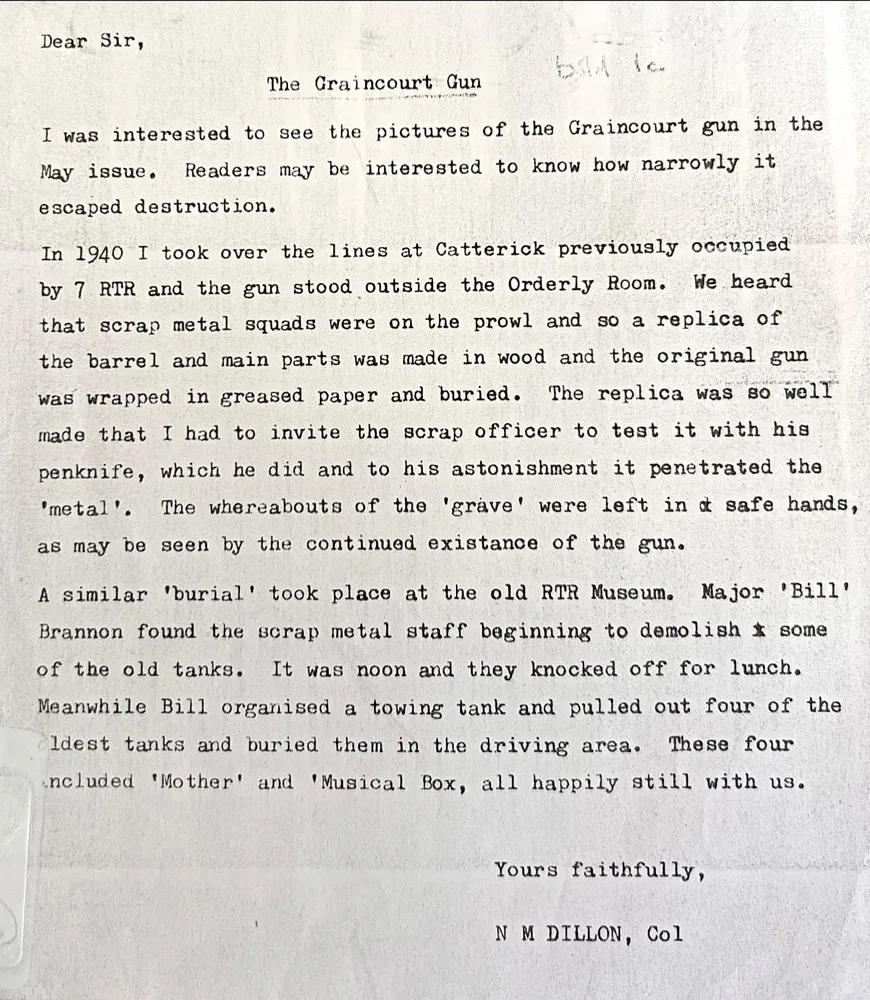
The team found Lieutenant Colonel N. M. Dillon’s 1982 letter while working through the museum archives. Written for the Tank Journal under the title The Graincourt Gun, it was chiefly about saving an historic artillery piece from the wartime salvage drive. Dillon described how the real components of the gun had been concealed, a wooden substitute had been used and the genuine parts had later been recovered. In the same letter, he recalled a similar episode at Bovington.
According to Dillon, Major A. C. “Bill” Brannon came across scrap workers starting to break up some of the old tanks. When they stopped for lunch, he arranged a towing tank and took four of the oldest machines away. Dillon wrote that the four were buried in the driving area, and named two of them, Mother and the Whippet Musical Box.
“These four included Mother and Musical Box”
Dillon had served at Bovington around the relevant period and knew Brannon. His letter gives the team a named officer, two named vehicles and an area to investigate. It was written decades after the event. It gives no burial plan and leaves open when the tanks were covered over, where each was put or what happened later.
The lunch break marks the opportunity to tow the tanks away from the scrappers. They could have been moved first and covered later, or an existing excavation could have been used. Both possibilities fit the kinds of work and equipment found at a wartime training establishment. The timing and sequence remain questions for the investigation.

Edward Bugden and a clue from his family
Edward Bugden served with the Royal Engineers before becoming Bovington Camp’s chief civil engineer. He worked at Bovington from 1939 until 1960, and his wartime responsibilities included major work around the camp, including the reservoir.
His son Richard came forward with family documents and a story he had heard from his father. Edward had said he helped Royal Tank Regiment officers bury old tanks in the early years of the war and told his children to keep it quiet. Richard’s sister also remembered their father speaking about the burial. The family’s account placed it broadly between the reservoir and the road, an area the team was already studying on wartime aerial photographs.
The recollection gives the investigation a second route into the story, through camp engineering rather than the old Tank Park. It identifies a general area and a man who had the means to carry out substantial groundworks. The family account leaves the identities of the vehicles open.

Nigel Duncan, George Forty and earlier enquiries
When Major-General Nigel Duncan returned to Bovington in 1947 to help rebuild the collection, he was told that some of the old exhibits had been buried, although their locations were no longer clear. An RAF search was discussed. Duncan’s recollection places the burial story in the early post-war years, before the 1951 scrapping account the team has traced. He was relaying what he had been told when he returned.
George Forty, who later led The Tank Museum, also pursued the story. His correspondence asked for people with first-hand information to come forward, and he explored whether the ground could be searched. The cost and practical difficulties of inspecting an extensive training area limited what could be done at the time.
Bringing these records together has meant comparing correspondence with unit records, photographs, maps and family accounts. Operation Mother is also tracing what happened to other vehicles from the interwar collection. Knowing when one tank moved or where an early photograph was taken can help narrow the possibilities for the others.

From the archives to the Dorset heath
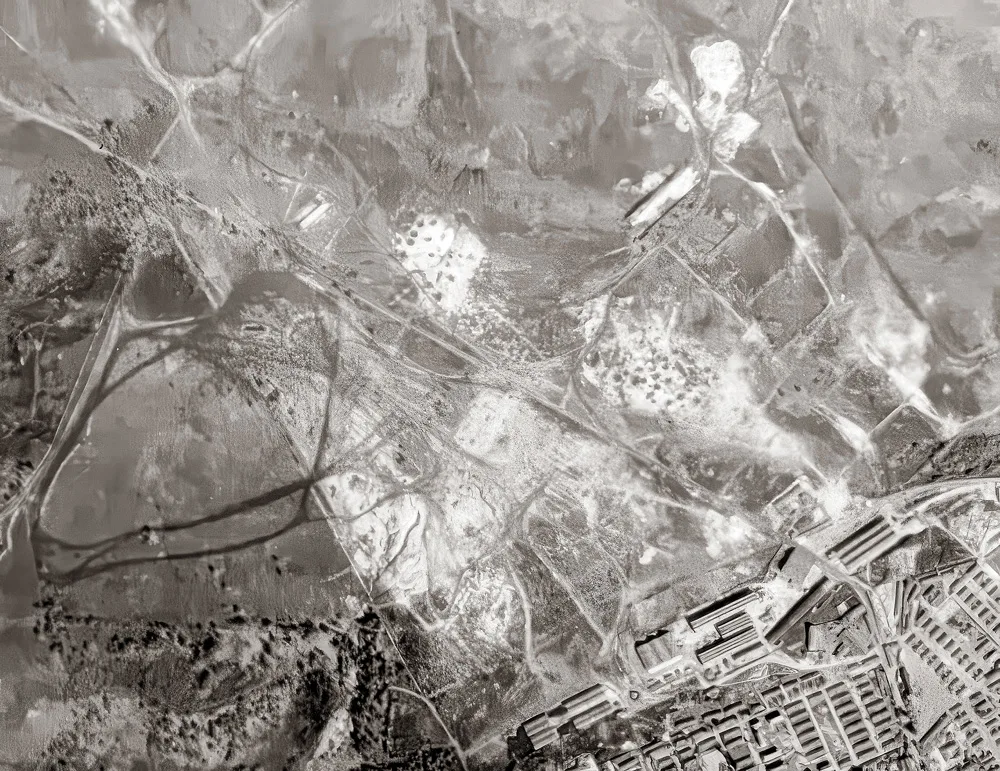
Wartime aerial photographs show four substantial ground disturbances in the old Driver Training Area. They include features large enough to make the practical question of concealment worth examining. Training and engineering work could also explain them. Comparing photographs taken at different times, period maps and the shape of the ground helps the team decide where a survey could answer a specific question.
Working with Cotswold Archaeology, the team completed an initial non-intrusive survey. A drone carrying a magnetometer measured variations in the magnetic field. It found no large metallic response in the strips it covered. Wet weather and uneven terrain made it hard to keep a low-flying sensor at a consistent height. LiDAR and other aerial imagery also helped record the surface, giving the team a way to compare the modern landscape with the wartime photographs.
The next phase is to extend the non-intrusive survey across roughly 32 hectares of the historic training area beyond the first site. The team is looking at a wider-area approach that can operate farther above the ground, subject to funding and the relevant permissions. Targeted follow-up would depend on what the survey finds. The work takes place on protected heathland and is planned around the permitted survey window.
Why Mother matters
Mother marks the point when the designers could put a machine over ground the production crews would have to cross for real. Those crews went to war in vehicles that were hot, deafening and prone to breakdown, with little experience to draw on. For Anthony, working through Mother’s story has made it easier to imagine the people inside the early machines and the problems they had to solve for themselves.
Finding the hull would be an extraordinary result. A photograph, a dated movement record or reliable evidence of scrapping could also settle a question that has been passed down around Bovington for generations. In the process, the project is gathering a record of the early tanks, the men who worked with them and the Dorset landscape where so much of that history took place.
Help us find Mother
Can you help with a clue?
We’d like to see photographs, postcards, letters, diaries, scrapbooks or newspaper cuttings that show early tanks around Bovington, Wool, Lulworth, Wareham and the surrounding villages. A tank in the background, a caption on the back of a photograph, or a family story about vehicles being moved could help us date or place a vehicle.
If you know who took a photograph, where it was taken, or who passed a story down, include whatever you remember. A photograph of both sides of a postcard or print can be particularly helpful.